.svg)
.svg)
.png)
Best Online Universities for International Students in Europe
Table of Contents

You can now earn a European university degree from a kitchen table in Lagos, a co-working space in Manila, or a rented room in Buenos Aires. The real decision is whether the degree you pick will be recognized, taught in a way you can follow, and built around people who came from somewhere else too. That's a different question than most ranking lists answer.
Most searches for the best online universities lead into US-built rankings, sized around US accreditation and visa rules that mean little once you're comparing a program in Spain to one in Finland. If you're applying from outside Europe, the questions that decide your outcome are narrower: who vouches for this degree, what does it actually cost, and will you be one of three international students in the room, or one of ninety.
Why does accreditation decide whether your degree travels with you?
Accreditation determines whether your diploma means anything once you cross a border, and in Europe it isn't automatic, even between two EU countries. A business degree earned in one member state can still need a national recognition procedure before an employer elsewhere treats it as equivalent, which is why checkable tools carry more weight than a university's own claims.
Germany's anabin database lets anyone verify whether an institution is state recognized, and the ENIC-NARIC network offers a comparable check across most of Europe. Tomorrow University went through this process in Germany, where the title "Universität" is legally protected, and became the first EdTech startup in the country to earn full state recognition as a university. Look for that same paper trail before trusting any school's claims about its own status.
What should tuition and payment terms tell you before you enroll?
Tuition for accredited online bachelor's and master's programs in Europe typically falls between roughly €3,000 and €15,000 a year, with online MBAs often running higher, up to around €20,000. Many European online universities charge international applicants the same tuition as EU applicants, a small fact that says a lot about how an institution actually sees you.
A school that quotes one number publicly and a different one once you've shared personal details, or offers only a single lump-sum payment with no installment plan, is showing you its priorities early.
Does the language of instruction shape who you'll actually learn with?
Language decides your cohort as much as geography does. A program taught only in the host country's language pulls a mostly local student body, while English-taught programs draw the internationally mobile crowd this format is built for. Tomorrow University added German-language delivery of its degree programs using real-time translation, so German and English speakers can sit in the same classes together. If a program calls itself international but teaches only in one language, ask how mixed the student body really is.
ToU Learning Experience
Get to know the modern way of learning: self-paced, while working and from anywhere.
GET CURRICULUM →Can you build a genuine global cohort without visa friction?
Yes, when the program is genuinely built for asynchronous study. Recorded sessions and flexible deadlines let students across very different time zones engage on their own schedule, while programs centered on fixed live sessions quietly favor whoever shares the host country's working hours.
Tomorrow University's cohort spans more than 95 nationalities, including professionals from companies like Tesla, Microsoft, and Deloitte, with occasional in-person meetups in European cities for anyone who wants them. That kind of spread happens when the schedule, language options, and community design are built around a scattered cohort from day one.
Which European online universities are actually worth shortlisting?
Study.eu's roundup of accredited, fully online universities offers a useful map. Malta's OPIT and Finland's HAMK take different accreditation routes but land in the same trust category. Spain adds EU Business School, Universidad Católica de Murcia, and UNIR, now one of the country's larger online providers with students in dozens of countries. The UK's Open University remains one of the longest-running distance universities anywhere, and Latvia's TSI and Germany's Tomorrow University show how newer institutions earn the same accredited standing through their own national systems. Run each name through anabin or ENIC-NARIC before it earns a spot on your shortlist.
What separates real support from simply being accepted?
Real support shows up before you've paid anything. Look for an admissions contact who answers specific questions and a syllabus you can actually read in advance. Staff should be able to explain how a project gets assessed, then stay reachable once you're enrolled and figuring out deadlines and academic writing conventions in a system you're still learning.
Watch for the classic warning signs behind online convenience: a single flat fee with no itemized costs, or degrees awarded mostly for "life experience" with barely any coursework. Vague talk of "international accreditation" from a body nobody can name is another one. Recognized institutions are happy to be checked. A diploma mill will dodge every one of those questions.
Turning Criteria Into a Shortlist You Trust
The strongest signal in this whole search is whatever you can check yourself. A university's homepage copy tells you almost nothing on its own. Foreign-origin students already make up 8.4 percent of tertiary students across the EU, a share that has been rising for years as mobility patterns shift. The institutions worth applying to are the ones that make verification easy to find.
Before sending a single application, run the same three checks on every school. Look it up in anabin or through ENIC-NARIC. Ask for the full cost breakdown in writing. Then find a current international student who'll tell you what the cohort actually feels like day to day.
Frequently Asked Questions
Do employers actually accept online degrees from European universities?
Yes, when the institution holds recognized state or national accreditation, employers treat it the same as a degree earned on campus. What they reject is an unaccredited or unverifiable provider behind the degree. Checking accreditation through anabin or ENIC-NARIC before enrolling removes most of that risk.
How long does it take to verify a university's accreditation status?
A basic check usually takes fifteen to thirty minutes. Searching the institution's name in Germany's anabin database or through your national ENIC-NARIC center gives a clear recognized or unrecognized answer, often faster than waiting on an admissions team's reply.
Will studying across time zones make it hard to keep up with coursework?
That depends far more on program structure than on the actual time difference. Programs built around asynchronous learning, with recorded sessions and flexible deadlines, work well across almost any time zone. Programs relying on fixed live sessions disadvantage students many hours away from the host country.
Are online degrees from European universities cheaper than studying on campus?
Often, though the gap varies by program. Annual tuition for accredited online bachelor's and master's programs typically runs between roughly €3,000 and €15,000, and many providers charge EU and non-EU students the same rate. Compare that against on-campus tuition plus relocation, visa, and housing costs.
Can international students really build a meaningful network in a fully online program?
Yes, when the university designs its cohort structure for it. Group projects and peer feedback, backed by optional in-person meetups, do more for real connection than a large enrollment number alone. Ask any program how many nationalities are active in its current cohort.
Join the Open Day
Meet Christian & Thomas (co-founders), hear real-world stories from our community and get your questions answered by our admissions-team.
REGISTER NOW →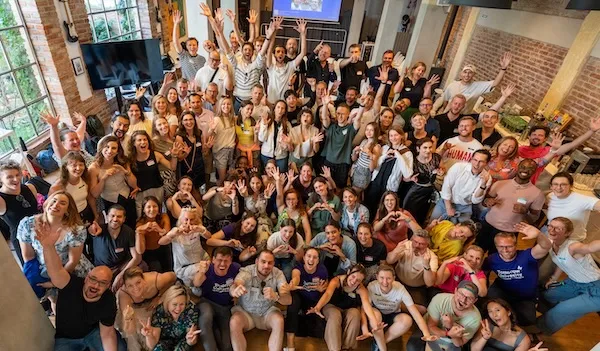
.svg)


