.svg)
.svg)
.png)
Online Master’s Degree vs MBA: Which Path Fits You?
Table of Contents
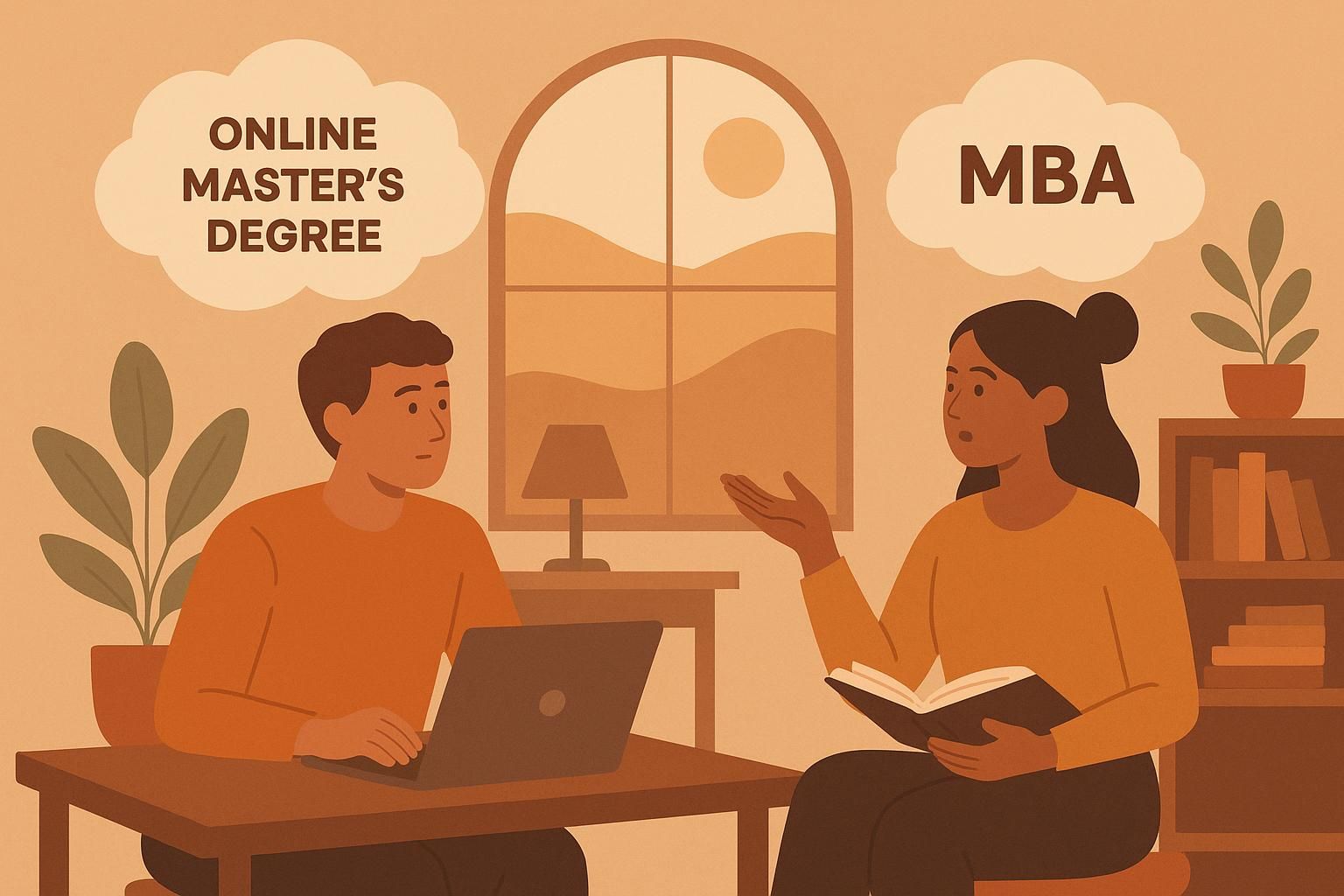
You've had two browser tabs open at midnight, one showing an online MBA program, the other a specialized online master's degree. Both look serious on paper and both let you keep your job while you study, but they answer two different questions. An online MBA widens how many parts of a business you can lead, while a specialized master's degree deepens your standing in one field you already know. That's the distinction that actually decides this, more than any ranking or price tag.
Once you frame it that way, the fog usually clears fast. Someone who wants to lead teams or eventually run their own venture is asking a different question than someone who already knows their lane and wants to become excellent in it. The rest of this comes down to matching your next five years to the right structure.
Are You Changing Direction or Going Deeper?
An online MBA suits people who want to change direction or lead more broadly, maybe even build something of their own one day. A specialized online master's degree suits people who already know their field and just want to go deeper into it. Get that fork right, and everything else in this comparison falls into place.
Picture a mid career professional feeling boxed in by their current function, tired of watching decisions get made without them in the room. For that person, the MBA's breadth is exactly what moves them forward, pushing them across strategy and finance and into leadership calls they haven't made before. Founders and future leaders tend to land here too, since building or running something means getting comfortable with both the financial side and the people side of a business at once. Tomorrow University's Impact MBA tracks, for instance, range from Responsible Entrepreneurship and Venture Creation to Conscious Leadership, which shows how differently an MBA can be shaped depending on where you're headed.
Now picture someone who already works in sustainability or in a technical field like data science and wants to become the person others turn to for real expertise. A master's degree serves that person better. Programs like Tomorrow University's Impact MSc pathways, including Sustainability Science and Climate Solutions or Data Science and Machine Learning, are built for the kind of focus you just won't get in an MBA's broader curriculum.
How Different Are the Curriculum, the Peers, and the Career Doors?
MBA classrooms jump between strategy and the messy cross functional calls that don't respect department lines, while specialized master's programs concentrate almost entirely on one field. Who sits next to you in a group project and what job title shows up on your CV two years later both trace back to this same split.
MBA cohorts tend to skew toward people already a few years into their career, which means your peer group doubles as a network of people who already manage budgets, teams, or clients somewhere. That peer group is often the most durable value of the degree, since a room full of people solving similar leadership problems becomes a resource long after graduation. Specialized master's cohorts, by contrast, often include people earlier in their career who are still building their first real expertise, so the network there tends to be technical and industry specific.
Career doors reflect that same divide. An MBA tends to open general management and founder paths, since employers read it as proof you can operate across a whole business. A specialized master's opens doors that already have your expertise written on them, sustainability analyst or data scientist, where depth in one area is exactly the point.
Ready to Build Your Future? 🚀
Does Accreditation or the School's Name Matter More?
What matters most is whether the accreditation is real and checkable. A famous school name counts for a lot less than most applicants assume. In Europe, MBA and master's accreditation runs mainly through AMBA, EQUIS, and AACSB, and knowing how they work protects you from paying a premium for a name that doesn't hold up under scrutiny. AMBA, the UK based accreditor, recognizes only around the top two percent of business schools worldwide, and fewer than one percent of schools anywhere hold accreditation from all three bodies at once, a status known as the Triple Crown.
Brand prestige is losing its grip as the deciding factor for a lot of applicants, and rightly so. A recognizable name tells you far less than a verified accreditation plus a state recognized status. Tomorrow University became a state recognized university in Germany after review by the country's Science Council, which is the kind of check worth doing for any online provider before you commit years and tuition to it. Don't take recognition on faith. Look it up directly.
Networking value splits along the same lines. If you're switching careers or building a company, the MBA's mixed room of experienced professionals is genuinely valuable, since your next opportunity might come from someone two seats over. If you're deepening a specialty, the more useful network often lives inside your field already, through conferences and the specific people doing the work you want to do.
Where Do Founders and Sustainability Careers Actually Fit?
Founders get more mileage from the MBA's breadth, since running a company means handling finance and people decisions in the same week, often before you feel ready for either. A venture creation track gives you practice making those calls before the stakes are real. People moving into sustainability or innovation roles split depending on the actual job they want next.
Someone who wants to lead sustainability strategy inside an organization, shaping how a company reports on ESG or restructures around net zero targets, fits an MBA track built around sustainability and ESG management. A lot of European business schools now weave sustainability straight into the MBA curriculum itself, treating it as core content rather than an elective bolted onto a generalist degree. Someone who wants to be the specialist building the climate solution itself gets there faster through a science or technology focused master's degree, the kind built around climate systems or applied data science, with more technical credibility to show for it.
Which Signal Actually Points to Your Next Step
Forget the letters after your name for a second. Look at the problem you're actually trying to solve next. If you're stuck because your job only lets you influence one piece of a bigger picture, the MBA's breadth is what gets you moving again. And if you're stuck because you want to go deeper into work you already love, a specialized master's takes you there without spreading you thin across subjects you don't need.
Before you apply anywhere, pull up the actual course list and the cohort profile of the program you're considering, not just the brochure page. See who else is in the room and what they went on to do. Checking who's actually in the room saves more people from the wrong degree than any ranking ever will. Tomorrow University's Impact MBA and Impact Master of Science programs are a concrete place to start comparing what each path actually looks like in practice.
Can I switch careers with a specialized master's degree, or do I need an MBA for that?
Either can work, but for a real career pivot the MBA usually does more of the heavy lifting. Its broad, cross functional curriculum is designed to prepare you for roles outside your current function, while a specialized master's degree works best when you're moving deeper into a field you're already connected to.
Is an online MBA taken as seriously as an on campus one?
Yes, when the program carries real, checkable accreditation and comes from a recognized institution. Employers increasingly judge an MBA by its accreditation and the caliber of its cohort rather than by delivery format, so an accredited online MBA from a properly recognized university stands on equal footing.
How long does an online MBA or master's degree usually take part time?
Usually two years or more, depending on pace and course load. Programs built for working adults are typically structured so you can adjust intensity around your job, which shortens or lengthens the overall timeline compared with a standard full time schedule.
Do I need work experience before applying to an online MBA?
Most MBA programs expect some prior work experience, since the format relies on peers bringing real management or industry situations into discussions. Specialized master's programs are generally more open to earlier career applicants, since they build expertise from the ground up rather than assuming it already exists.
What matters more, the specialization or the school's name?
The specialization matters more for most career outcomes, especially once you look past a small handful of globally famous schools. A well matched, properly accredited program in the right specialization will usually serve your career better than a prestigious name attached to a curriculum that doesn't fit what you're actually trying to do next.
Mission Identification
Defining your purpose and creating a personal mission statement are the foundations of both personal and professional success.
EXPLORE THE CHALLENGE →
.svg)


.avif)