

Nothing Was Missing. Sorana-Stefana Lehene Left Medical Science Anyway.
Sorana-Stefana Lehene had a bachelor's and two master's degrees in medical science, and a research job in molecular toxicology in Uppsala. She had top grades all the way through. Leaving the field meant disappointing the people closest to her.
Table of Contents
A career that worked on paper
Sorana-Stefana Lehene worked in a molecular toxicology research team in Uppsala, Sweden. Her days ran from eight in the morning until seven at night, and often through the weekend. "I was home when I was sleeping mostly," she says.
She was good at the work. "There was nothing missing. Everything was fine. It's just that medical science is not for everyone."
"Just because you're good at it, it doesn't mean that you should do it."
She'd wanted to quit a year earlier and didn't have the courage. Most of the people around her were doctors. "I tried to stay there so I could make everybody happy, but I was very unhappy."
She had already tried to fix it inside the field. She trained in forensic science, the work she actually wanted. Then she looked for a job in her home country, in Germany and in Spain. Eight months, nothing. A second master's, this one research-focused, didn't help either.
Why she applied to our BSc in Artificial Intelligence & Sustainable Technologies
Robotics and science fiction had interested her since childhood. When AI came along, she was reluctant to use it. Then she quickly got curious. In 2023 she started looking for an education in it that she could do from Sweden, where the only options were computer science and computer engineering.
She found us on Trustpilot, with a rating she describes as unusually good. The website was new and polished. "Everything was a bit too nice. So I thought it was fake, but I was desperate enough to want to find out more."
Her first interview was with Christian Rebernik, one of our co-founders, and ran over an hour. He put the problem to her directly: she had no math or physics from school or university, and would learn the field from scratch. Why did she want that? She told him about her background, and then: "I can't be here. I don't want to be here. I want to do something that makes me happy. I want to do something that I'm passionate about, not just something that I do for money."
For her student funding, she then had to prove to the Swedish government that we were a real university, which took another three months.
She applied in March 2023, quit her job in June, and started later that year, in an intake of 11. She didn't have the informatics credits for a master's. So she took the Orientation phase from the bachelor's, where learners set their direction, then moved on to master's courses.
Three weeks, real data, and a plan the company kept
Her favorite challenge came in 2025, in the later Elevation phase. Her team calculated the greenhouse gas emissions of a mid-sized company and worked out how to bring them down. "We worked with their real data from the last four or five years, real use cases, real protocols, everything." They went sector by sector: materials, vehicles, electricity in the offices. The company approved the resulting plan and started on it.
Everyone else in the group was over 30, much older than her, and it worked. "We were so in sync and everything worked so well and everybody worked so hard and we achieved so much in three weeks."
That was Challenge-Based Learning in practice: a real company and its own data instead of a case study.
She's straightforward about her other two Elevation challenges. Sometimes a teammate didn't do much. Sometimes the group couldn't agree and submitted several options instead of one.
The hardest stretch
She was running a startup alongside her studies, and toward the end it got so intense that keeping up with the tasks and the challenges got hard. She was also taking jobs she didn't want, for the income, and dealing with challenges in her relationship while writing her thesis.
People told her to take a break and freeze the year. She didn't. She could have taken until October to finish. She submitted her thesis in February 2026 and had everything finished by March 3. "I am a very ambitious person," she says. "If I say I finish something and I have a deadline, then I'm going to respect the deadline."
A mentor and five friends
Christian, who asked her why in that first interview, is her mentor now. He still gives feedback on her ideas.
Five people from those years are still close friends. One of them lives in Malmö, and they meet often.
Four times a year, the whole university meets in person at the Immersions, each time around a theme. She says she went because of those friends. In her whole time as a learner she only missed one Immersion.
Working with startups after all
She'd always said she would never be an entrepreneur. "And then I end up doing exactly that."
She says it started in the Orientation phase, in a challenge on technology revolutions. Her team had to propose something revolutionary they would build, which she calls "already entrepreneurial thinking." She enjoyed it.
She worked as an AI architect for a while, then decided coding wasn't creative enough for her. She moved into marketing for AI products, which she says she couldn't do without understanding how they work.
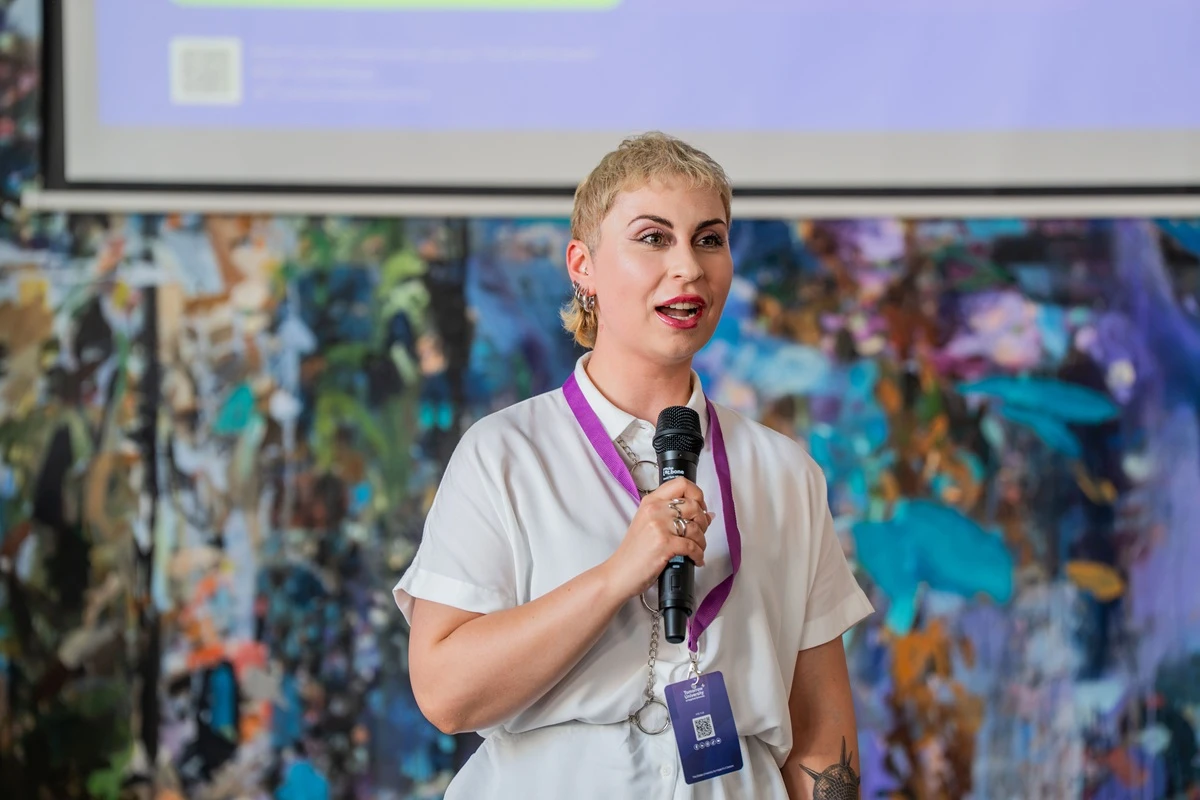
Now she's a marketing consultant for two companies. She also manages and moderates startup events and gets booked to run AI workshops. She says all of it connects back to startups.
"I don't hate working," she says. "I honestly very many times don't even feel like I'm working because I enjoy what I'm doing so much."
What would she say to someone sitting where she sat?
"It's okay to be afraid, but just take that step. Just make that change." And if the feeling won't leave: "If it's always in the back of your head that it's not the life that you want to live, then it means that you have to change something so that you're happy."
"Work can be enjoyable."
Start turning your passion into action. Take your Program Finder Quiz.


