.svg)
.svg)
.png)
What Studying Online While Traveling Can Teach You
Table of Contents

Studying online while you move between cities sounds like the dream version of a degree, until the first quiet morning in a new place when nobody hands you a timetable. Remote studying teaches you that freedom only works when you can build the structure for yourself, that connection can travel with you, and that growth often gets clearer when your degree does not keep you in one spot. Most of the real learning sits outside the syllabus.
If you are pointing your degree in the same direction as your next flight, you have probably already asked yourself the same three questions. Will you miss the social part of student life? Are you actually disciplined enough to make this work without someone checking in on you? And why does it feel oddly lonely to choose a path none of your friends are choosing, a quieter doubt than most people admit to carrying. These questions come up constantly among people building a degree around a location-independent life, and they are worth answering honestly rather than waving away.
Before the chapters below, here is the tension this article unpacks and the lessons most digital nomad students keep running into once they actually start.
Flexibility feels empowering once you stop waiting for a timetable to tell you what to do with your week.
Travel sharpens self-discovery because every new place asks you to rebuild your rhythm from scratch.
Belonging depends on showing up, not on being in the same room, once the social part changes shape.
Autonomy is a practice, not a personality trait you need to have polished before you enrol.
What does remote studying teach you about flexibility?
Online study teaches flexibility first, because nobody hands you the shape of the day. You still carry the responsibilities you had before, you just decide when and how the work fits around them, which is a different relationship with your own time than any classroom ever offered you.
Nele Meinert, a current learner at Tomorrow University, calls it "one of my best decisions" because she gets to design her day the way she wants. That is not a holiday promise. It is a shift in ownership, and the freedom only works once you also own the plan that makes the freedom usable.
The lesson most people do not see coming: flexibility can feel uncomfortable before it feels easy. A campus timetable removes a hundred small decisions for you. Remote study hands them back, and that handover is where the growth actually starts.
Will an online degree feel lonely?
An online degree feels social when the university treats connection as part of the experience, not an afterthought. The fear is still real, because online study removes the casual contact most people quietly count on when they picture student life.
That early question, "will I miss the social part?", deserves an honest answer rather than a reassurance. At Tomorrow University, community does not depend on one shared building. Learners meet in live sessions, build trust through project work, and recognise themselves in the moments when somebody else is also trying to figure things out. If you want the longer version from the people inside it, our learners describe what that feels like in their own words on studying together from different places.
Online study does not copy campus life. It asks you to practise a more active kind of belonging, where you join the conversation because the conversation is the room.
Ready to Build Your Future? 🚀
How does travel change remote studying?
Travel changes remote studying by making learning part of daily life instead of something that happens in one fixed place. Moving around does not soften the degree: assessments still land on schedule, and the work still has to get delivered wherever you happen to be that week.
One learner's answer to the doubters says it best: "That is not studying? It is!" You can travel and still do the work, and the point is not that every day looks beautiful from a café window. The point is that the work keeps its weight even when the surroundings change.
Many digital nomad students do not want to tie themselves to one place for three or four years, because travel gives them room for self-discovery. Every move asks you to rebuild your rhythm. Every new environment shows you something else about how you focus, where you get tired, and what kind of place you actually grow in.
Which skills does remote studying build?
Remote studying builds practical skills quickly, because the format makes you use them every week. Discipline stops being a self-image question and becomes a repeated act you can point to.
Less procrastination is usually the first shift digital nomad students notice, alongside time management, self-motivation, independent problem-solving, and the kind of digital communication that only becomes real when your classmates are not sitting beside you. That last one matters more than most prospectuses suggest. A lot of this gets sharper when the work itself is built around real problems rather than memorising for an exam, which is the logic behind our approach to learning through real-world challenges.
This is the part many people underestimate. The degree teaches content; the format teaches a way of working. If you can plan your energy when the day is yours, that skill outlives the program. If you can collaborate through a screen, the same applies. Even recovering from a bad study day quietly becomes part of the training.
Why does autonomy matter in an online degree?
Autonomy matters in an online degree because the structure supports you without taking over your choices. That means taking full responsibility for what you do and what follows from it.
One Tomorrow University learner put it this way: "Autonomy means taking full responsibility for my choices and actions. By owning both successes and mistakes. And isn't this a perfect way to grow?" That line keeps the article honest. Remote studying is not only convenient. It quietly exposes the places where you still want somebody else to decide for you.
If you feel odd because none of your friends are doing this, autonomy may be the deepest lesson on offer. You stop treating other people's path as proof that yours is valid, and you start choosing, adjusting, and owning the result. That kind of ownership is also what we mean when we talk about building a life around your own sense of purpose.
The learner you become while traveling
The doubts that make online study feel risky end up doing some of the teaching. If you worry about discipline, the experience gives you a real place to practise it. If you worry about friendship, it pushes you to build connection with more intention than campus life usually demands.
Remote studying asks for honesty before it asks for perfection. If travel matters to your growth, a serious degree does not have to keep you still. And the useful question is not whether your friends would choose this, but whether this life would help you become more responsible with your own freedom.
Before you decide, try one small exercise. Sketch one ordinary week in the life you want to live while studying. Mark one daily block where the work actually happens, and name one person or community you would turn to when your motivation slips. If both feel possible, you already have the start of an answer.
Frequently Asked Questions
Can I study online while traveling for months at a time?
Yes, if the program is fully online and you can protect real study blocks while you move. Travel does not cancel the study part: assessments still land on schedule, and you still have to deliver them on time. The honest question is whether you can treat each new place as somewhere work still happens.
How do I know if I am disciplined enough for remote studying?
You do not need perfect discipline before you begin. You need enough willingness to set a plan, sit down when nobody is watching, and ask for support when your rhythm slips. Discipline grows inside the experience, not before it.
Will I miss campus friendships in an online degree?
You might miss the easy visibility of campus life, but that does not mean you study alone. In an online degree, friendship grows through repeated contact and shared project work. You have to show up more deliberately, because nobody can bump into you after class and turn that into a coffee.
What if none of my friends are choosing remote studying?
That feeling is normal, and it can make the decision seem riskier than it actually is. Many digital nomad students notice the same distance between their own choice and their friends' choices when they start. Remote studying asks you to trust your own path before your social circle has proof that it makes sense.
Join the Open Day
Meet Christian & Thomas (co-founders), hear real-world stories from our community and get your questions answered by our admissions-team.
REGISTER NOW →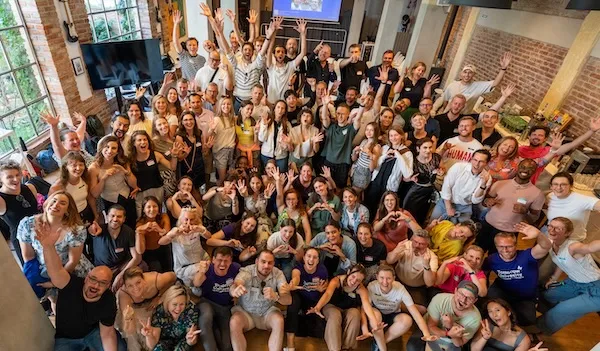
.svg)