.svg)
.svg)
.png)
How an Online Master’s Degree Works for Working Adults
Table of Contents

You submitted the application, maybe even opened the acceptance email, and now the excitement is fading into a more practical question: what does Monday actually look like. An online master's degree behaves less like a stack of recorded lectures you binge whenever you feel like it, and more like a job with its own weekly calendar. A well designed program runs on a weekly rhythm of short independent lessons you fit around work, anchored by one or two live sessions with your cohort. Project deadlines then pace the whole term in a handful of checkpoints, and that rhythm decides whether the degree fits into your actual evenings.
What Does a Typical Week in an Online Master's Program Look Like?
Most weeks split into two layers: material you work through on your own schedule, and moments where you show up live with real people. The independent part is short readings or a task you finish whenever your day allows, at six in the morning or on a train between meetings. The live layer is smaller but non negotiable, a seminar or a cohort session where a facilitator and your classmates are waiting for you.
Rotterdam School of Management pairs independent readings with mandatory weekly live lectures and panel discussions in its online master's programs. Tomorrow University runs a version built around challenge based learning, where short daily lessons feed into one weekly live session with the whole cohort. Deadlines follow the same logic: a handful of checkpoints across the term, each tied to a prototype or report you can show someone afterward.
How Much Time Does an Online Master's Degree Actually Take Each Week?
Honestly, it is more than a single evening a week, but it is spread far thinner than a full time campus load. European master's programs are measured in ECTS credits, and one credit stands for roughly 25 to 30 hours of total work, covering class time, plus reading and assignments. A master's runs 60 to 120 credits, which is why a full time year adds up to somewhere around 1,500 to 1,800 hours, according to the European Credit Transfer and Accumulation System every EU program is built on.
Spread across two or three years, that same workload turns into a far more livable weekly number. Tomorrow University describes a working week built from lessons of seven to fifteen minutes each, plus one ninety minute live cohort session, landing at roughly ten hours a week. The real question for your own week: do the daily chunks fit a lunch break, or do they quietly assume you have a free afternoon.
What Separates Real Learning Design From Just Watching Lecture Videos?
A stack of recorded lectures with a quiz at the end is content delivery. Real learning design gives you what a video never can: someone who actually reads your work and tells you what to fix, and a project you have to build and then defend in front of real people.
Mission Identification
Defining your purpose and creating a personal mission statement are the foundations of both personal and professional success.
EXPLORE THE CHALLENGE →
In a lot of European programs, the way you're graded looks completely different too. Some universities build challenge based learning into the degree itself: you start with a real problem you actually care about, dig into it, then test and present a solution, picking up feedback the whole way through, long before any grade gets assigned. Tomorrow University's own challenge based learning model follows that cycle, and its no exams approach replaces exam dates with portfolios and milestone reviews tied to work you would actually do on the job, the same challenge based approach Malmö University and the wider ECIU network of European universities have built teaching strategies around. Peer feedback is what makes any of this stick. When your motivation dips on a Tuesday night, it is the classmates reading your draft and telling you what to fix that keep you going.
How Do You Know a Program Is Actually Built for Working Adults?
Start with accreditation first, since it is the one signal you can actually verify yourself. In Germany, every bachelor's and master's degree, including fully online ones, must pass formal quality accreditation, checked by an agency licensed under the national Akkreditierungsrat. That removes one worry, but it does not tell you whether the program respects your calendar.
Look at the smaller, practical signals next. Is there a real person, a program manager, who checks in when your job gets loud? Rotterdam School of Management builds exactly that kind of support into its online masters. Does the cohort span genuinely different time zones and life stages? Tomorrow University's own learner community is built around that kind of mix. And does the program treat in person contact as genuinely optional? Tomorrow University's quarterly gatherings in Berlin or Vienna work as an add on you can join or skip, worth checking if travel is a constant in your life, as this piece on online degrees for digital nomads lays out.
Your Calendar Is the Real Entrance Exam
Honestly, this has almost nothing to do with how smart or driven you are. It comes down to one thing: does the weekly rhythm actually fit into the life you already have, mess and all, including the weeks something drags you off to another country.
This kind of fit is worth checking before you apply anywhere, not after. Ask to see an actual weekly schedule, and ask who reads your work when your job explodes for a week. If you want to see what that looks like inside a project based, exam free design, Tomorrow University's Impact Master of Science is one concrete place to start comparing against.
Questions Working Adults Ask Before They Apply
Can I really keep working full time while doing an online master's?
Most learners are doing exactly that right now. Programs built for working adults keep daily lessons short and pack live contact into one or two sessions a week.
What happens if a busy week at work makes me fall behind?
You'd be surprised how forgiving these programs are. The independent material catches up in a few days, and since grading runs on milestones, one bad week barely shows in your final result.
Are online master's degrees taken seriously by employers?
Employers look mainly at the accreditation behind the degree. A university offering the same qualification on campus and online usually issues graduates the identical academic credential.
Do I have to log in at a fixed time every week, or can I catch up later?
Just the one or two live sessions a week are fixed. Everything else you work through whenever suits you, but those sessions are where the cohort actually talks, so people expect you there.
Is there any in person contact, or is the entire degree remote?
Usually optional. Most degrees run fully remote, and Tomorrow University, for instance, adds a few optional in person gatherings across European cities each year on top of that.
Join the Open Day
Meet Christian & Thomas (co-founders), hear real-world stories from our community and get your questions answered by our admissions-team.
REGISTER NOW →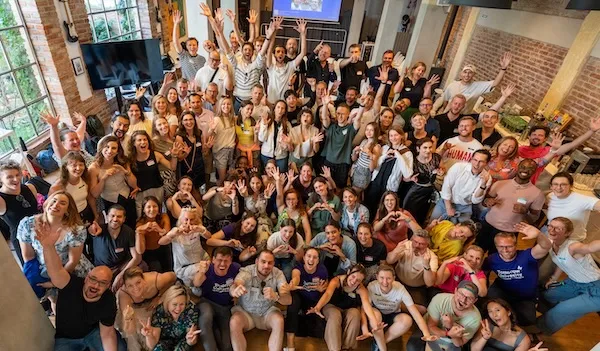
.svg)